

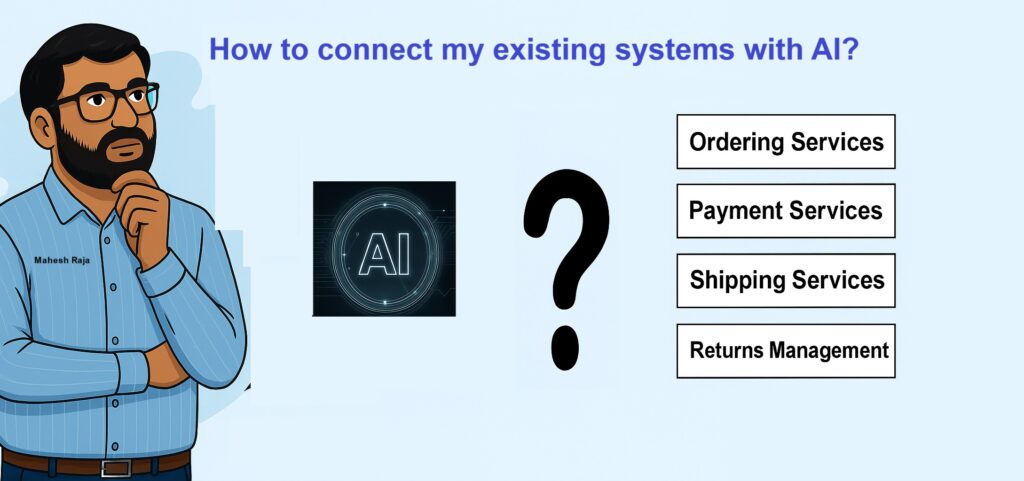
Over the years, I’ve been deeply involved in building, integrating, and scaling enterprise systems—first in the Java ecosystem, later across platforms like MuleSoft, Salesforce, and more recently, AI-driven architectures. And if there’s one recurring theme I’ve observed, it’s this: our systems are only as smart as the context they carry.
When I first came across Model Context Protocol (MCP), it immediately resonated with me because it addresses a gap I’ve felt for years—the lack of a standard way to supply models with the right context, securely and consistently, across different systems.
The Need I Felt for MCP
In most real-world enterprise setups, we struggle with:
- Context fragmentation: Data lives across CRMs, ERPs, integration layers, and external APIs, making it hard for any single system (or AI model) to see the bigger picture.
- Ad-hoc integrations: Every time we bring a new system into the ecosystem, teams reinvent the wheel to feed it relevant data in the format it expects.
- Scalability and governance issues: Context sharing often lacks standardization, leading to brittle integrations, higher costs, and governance blind spots.
As an architect, I’ve often wished for a protocol-based way to pass context to systems, much like how APIs standardized application-to-application communication. That’s exactly where MCP shines.
Why MCP Feels Like a Breakthrough
The Model Context Protocol changes the game by offering a common language for systems, tools, and AI models to share and consume context. Here are the benefits I see as transformative:
- Consistency Across Systems
With MCP, every system can provide and consume context in a standardized way. No more custom glue logic or fragile middleware hacks. - Interoperability with AI Models
The rise of AI has made context even more critical. MCP ensures that models—whether they’re LLMs, IDPs, or recommendation engines—get the right context at the right time, boosting accuracy and relevance. - Scalability Without Chaos
In practice, as enterprises adopt more tools and AI-driven components, scaling integrations becomes nightmarish. MCP introduces a unifying layer, making it easier to onboard new systems without breaking existing ones. - Enhanced Security and Governance
By standardizing how context is shared, MCP makes it easier to track, audit, and enforce governance. This is crucial for compliance-heavy industries like banking, healthcare, and telecom (domains I’ve personally worked in). - Future-Proofing Architecture
MCP is not tied to one vendor or tool. It opens the door to a plug-and-play ecosystem where systems can evolve independently but still stay interoperable.
My Perspective as an Architect
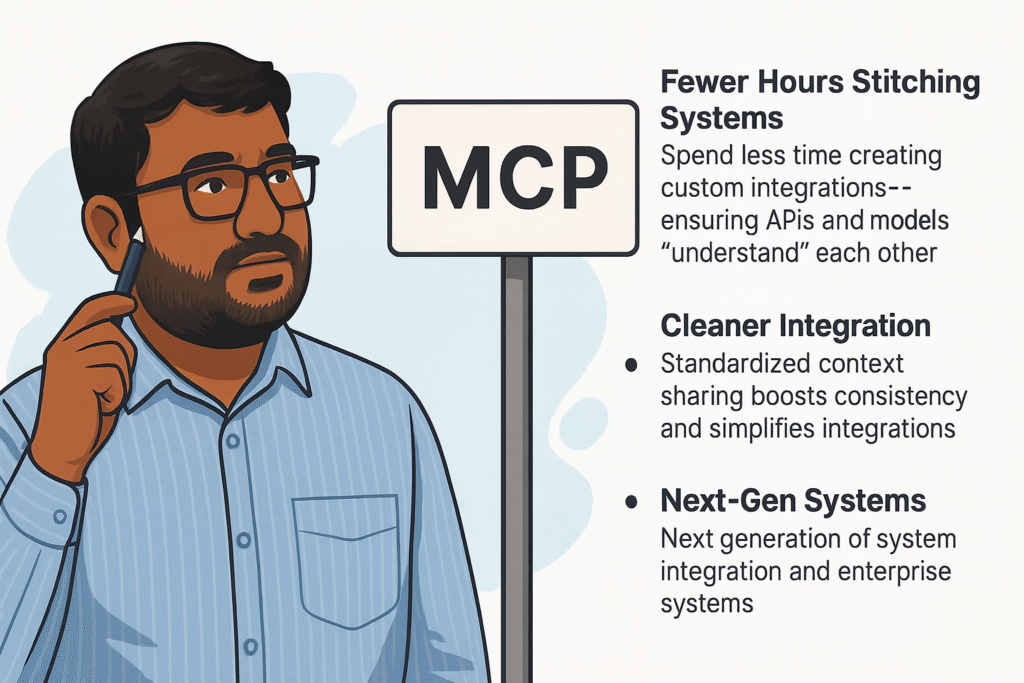
Looking back at the countless hours my teams have spent just stitching systems together—ensuring that APIs, queues, and models “understand” each other—I can say this confidently: had MCP been around earlier, integration would have been far simpler, cleaner, and future-proof.
This protocol is not just another technical spec—it’s an enabler for the next generation of intelligent, interoperable enterprise systems. It reduces friction, improves agility, and most importantly, lets architects like me focus less on plumbing and more on designing experiences and outcomes.
Stay connected…
For me, MCP represents the kind of evolution we desperately need in enterprise and AI ecosystems. It acknowledges that context is king—and finally gives us a standardized, scalable way to provide it.
In the coming years, I see MCP becoming a foundational element, much like APIs and microservices once did. And as someone who has spent years wrestling with fragmented integrations, I can honestly say: this is the kind of game-changer I’ve been waiting for.