

It was during my engineering days that I first came across Artificial Intelligence (AI) as part of my curriculum. Back then, we were limited by the processing power and automation capabilities of the time. To put it into perspective: the PC I used for programming practice had just 32 MB of RAM and 4 GB of storage. Fast forward to today, my personal mobile device alone boasts 12 GB of RAM and 1 TB of storage, with another 1 TB of cloud storage on my Google account.
The contrast couldn’t be sharper. What once seemed futuristic has now become part of our everyday environment.
From Theory to Practice
For the last 2–3 years, as AI became the talk of every boardroom and technology meetup, I began putting my theoretical knowledge into practice. I explored various AI models and experimented with real-world applications.
Most of you who follow me on LinkedIn know me as a Salesforce + MuleSoft + Java Spring Full Stack Architect. But I’ve also been fortunate enough to stretch my architectural mindset and apply it to practical AI use cases—some successful, some not so much. Both have been valuable learning experiences.
On the office floor and in professional community forums, I am frequently asked about AI: its impact, its risks, and its role in reshaping IT. This post is my first step in narrating those footsteps toward AI adoption—successes and failures alike.
Why AI is Everywhere
Today, whether you are a regular citizen or a company leader, everyone is talking about AI. But what’s driving this surge? A few key factors stand out:
- Cloud Adoption → Easier, faster scalability of AI workloads.
- Automation Demand → The relentless pursuit of efficiency.
- Cheaper Compute Power → GPU advancements and cloud economics.
- Generative AI Revolution → Democratization of models like GPT, Claude, and more.
- Regulatory Shifts → Clearer policies enabling responsible experimentation.
One case study I often cite is of an organization that was able to recoup its entire AI investment within a single year of adoption. That’s the kind of business impact AI is now capable of delivering.
The Era of AI Experiments is Over
We are no longer in the “AI experiment” phase. AI is not just a “nice-to-have”; it has become a core engine for business growth.
According to Gartner’s Hype Cycle, AI has already overcome the early hype and challenges. Today, Generative AI sits in the Trough of Disillusionment—which is not a bad thing. It simply means that organizations are now moving from inflated expectations to practical understanding of AI’s true potential and limits.
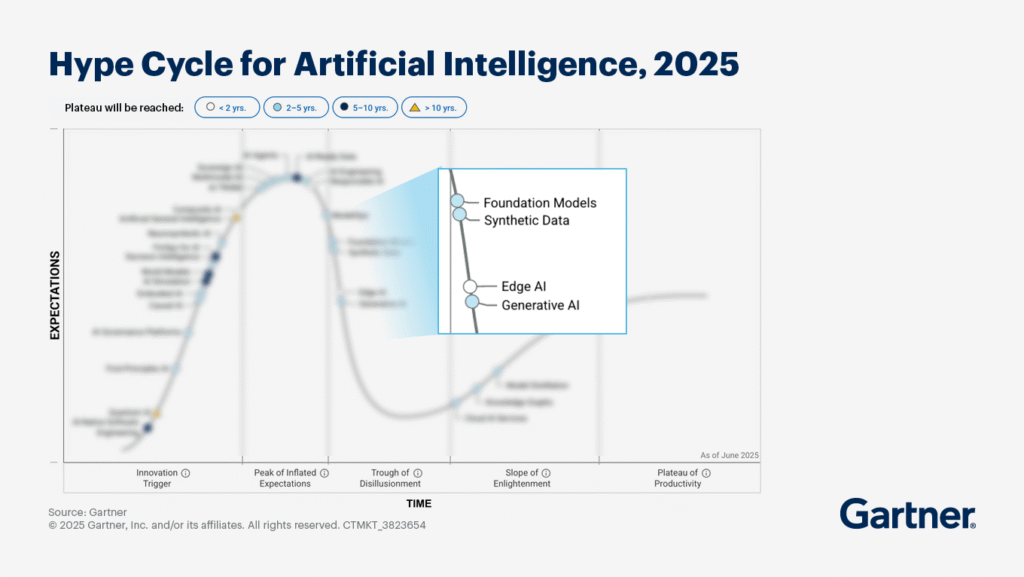
For leadership, the question is no longer “Should we adopt AI?” The real question is “How do we strategically deploy it to create tangible business outcomes?”
A Telecom Story: From Reactive to Proactive
Having worked in the telecom industry for over a decade, I’ve seen firsthand how critical AI can be. One of my recurring challenges was to:
- Increase customer self-service adoption, reducing calls to the help desk.
- Optimize network performance.
- Drive predictive maintenance to cut infrastructure costs.
Here’s where AI changes the game:
- Real-Time Anomaly Detection → AI models can now analyze massive volumes of logs and network traffic to detect early warning signals of equipment failure.
- Proactive Action → Instead of waiting for issues to surface, AI-powered systems can reroute traffic, run diagnostics, and even schedule a technician—before the customer ever notices.
This shift from reactive to proactive doesn’t just improve customer satisfaction. It also significantly reduces operational costs and downtime—something that was unimaginable back in my engineering days with 32 MB RAM machines.
Lets be in touch
AI has traveled a long way from being an academic subject in my classroom to becoming a business-critical enabler in today’s enterprises.
Yes, the journey of learning AI while managing demanding projects is a struggle. But it is also rewarding. For me, it has been about bridging the gap between my core architecture expertise and the new AI-driven paradigm.
The lesson is clear:
- AI is not just about algorithms and models.
- It’s about architects, leaders, and enterprises strategically embedding AI into their DNA.
- Connect with me at https://www.linkedin.com/in/maheshrajav/
- I am ready to help and guide